E-Lotto.com | The Only Fully Digital Lottery Experience
E-Lotto.com – The Future of Global Lotteries Has Arrived
For generations, lotteries have remained remarkably unchanged. Players purchase physical tickets, wait for scheduled draws, check printed results, and, if fortunate enough to win, often face a lengthy claims process involving retailers, lottery operators and manual verification. While technology has transformed banking, shopping and entertainment, the lottery industry has continued to rely on systems that were largely designed decades ago.
E-Lotto.com has been created to change that.
Built from the ground up as a fully digital global lottery platform, E-Lotto.com represents a new vision for how lotteries can operate in the modern world. Rather than simply acting as another online ticket seller, the platform has been designed around transparency, automation, security and worldwide accessibility. It combines blockchain technology with digital ticketing to create an ecosystem where every transaction is securely recorded, every ticket is permanently stored and every prize can be verified automatically.
The result is a lottery platform built for the internet age.
Instead of relying on physical tickets that can be lost, damaged or stolen, every ticket purchased through E-Lotto.com exists digitally. Once purchased, ownership is securely recorded, creating a permanent record that cannot be altered or misplaced. Players never have to worry about forgetting where they placed a ticket or wondering whether it has expired in a drawer. Their entries remain safely stored within their account, ready to be automatically checked against the winning numbers.
This digital-first approach eliminates many of the frustrations traditionally associated with lottery play while providing a significantly more convenient experience for players around the world.
One of the biggest innovations behind E-Lotto.com is its use of blockchain technology. Every ticket purchase, transaction and recorded result is stored on an immutable digital ledger, providing complete transparency throughout the entire process. Rather than asking players simply to trust the system, blockchain allows information to be independently verified, creating an additional layer of confidence and accountability.
Transparency has become increasingly important in online services, particularly where money is involved. By recording transactions on blockchain technology, E-Lotto.com aims to demonstrate that fairness, security and openness can work together to create a more trustworthy lottery platform.
Automation also plays a major role in the platform’s design.
Traditional lottery winners may need to submit claims, present physical tickets, complete paperwork or wait for prize verification before receiving their winnings. E-Lotto.com has been designed with smart contract technology in mind, allowing winning tickets to be identified automatically and eligible prizes processed without unnecessary delays. Once a winning ticket has been verified, the system can instantly initiate prize distribution according to the platform’s operating rules.
Removing manual intervention reduces delays, eliminates many opportunities for human error and creates a faster experience for players.
Security has been a central consideration throughout the development of E-Lotto.com. Every account benefits from modern encryption technologies designed to protect personal information and financial transactions. Digital ticket storage also provides significant advantages over traditional paper-based systems, ensuring that tickets cannot simply disappear between purchase and draw day.
For players, this offers peace of mind that their entries remain safely stored and readily accessible whenever they wish to review them.
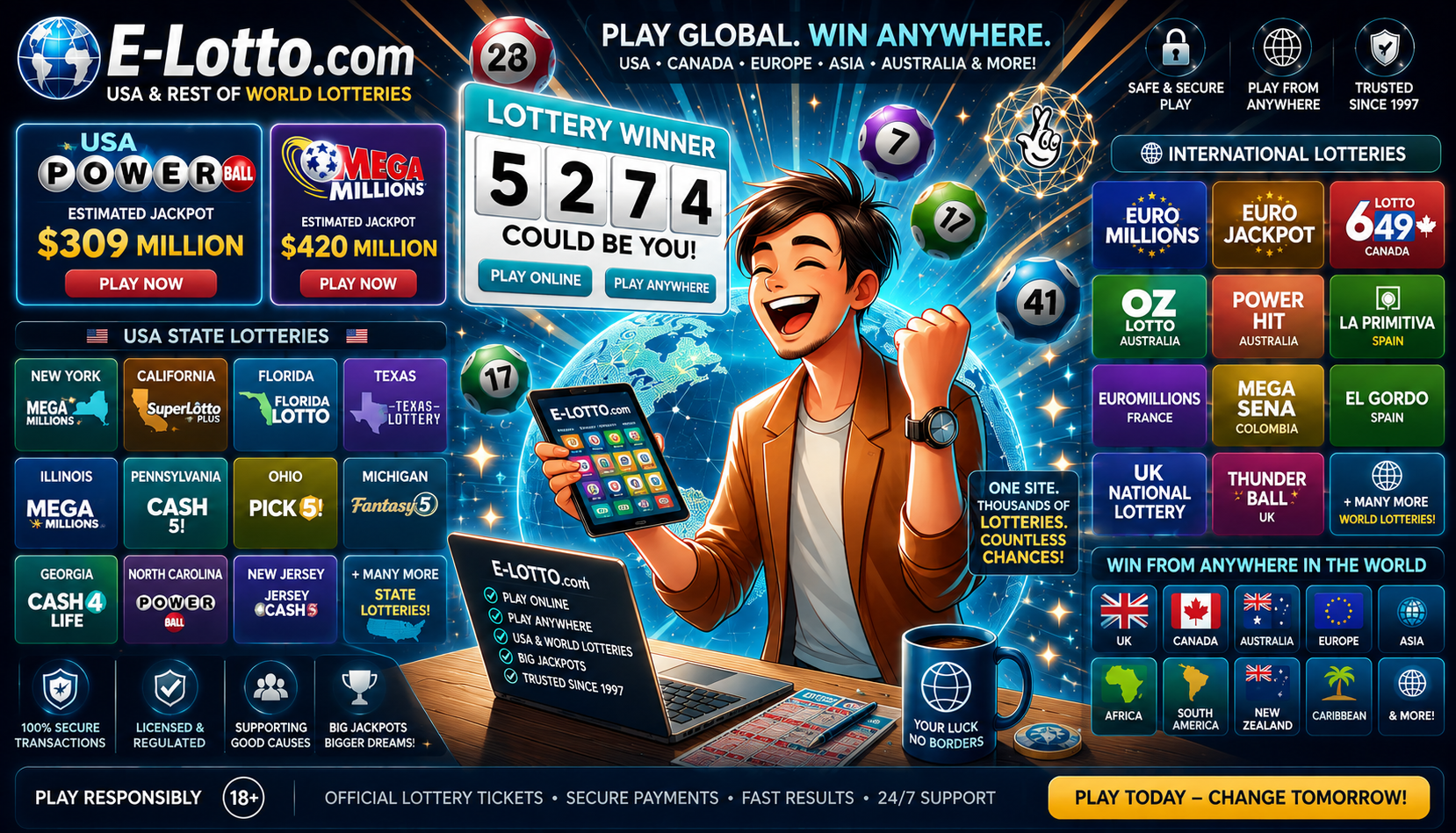
Unlike many traditional lottery services that primarily serve a single country, E-Lotto.com has been conceived as a genuinely international platform. Its ambition is to provide access to some of the world’s most recognised lotteries from a single digital destination, allowing players to compare opportunities from across multiple jurisdictions.
Whether someone wishes to explore American jackpot games, European lotteries, Australian draws or other international opportunities, E-Lotto.com aims to bring these options together within one integrated platform.
Major games such as Powerball, Mega Millions, EuroMillions, El Gordo and numerous other national and regional lotteries represent the type of global catalogue that E-Lotto.com is designed to showcase. Rather than visiting multiple websites to research different games, players can compare jackpots, prize structures, draw schedules and other important information from a single location.
Helping players make informed decisions is another important objective.
Different lotteries appeal to different people. Some players prefer enormous jackpots with longer odds, while others favour games offering better winning probabilities or more frequent draws. E-Lotto.com provides comparison tools that allow players to evaluate lotteries side by side, considering jackpot sizes, odds, draw frequencies, participating countries and other useful information before deciding which games best suit their preferences.
The platform has also been designed to embrace the growing diversity of payment technologies available worldwide.
Alongside traditional fiat currencies, E-Lotto.com supports cryptocurrency payments, giving players greater flexibility when purchasing tickets. As digital assets become increasingly mainstream, providing both conventional and cryptocurrency payment options helps make the platform accessible to a broader international audience while supporting faster and more flexible transactions.
Another important aspect of the E-Lotto.com vision is charitable giving.
Rather than treating charitable donations as an afterthought, the platform aims to incorporate philanthropy directly into the player experience. Players can choose which charitable organisations or causes they wish their purchase to support, creating a more transparent and democratic approach to giving. This empowers players to direct a portion of platform revenue towards causes that matter most to them, whether those involve medical research, environmental projects, humanitarian initiatives, education or community programmes.
By allowing players to participate in the decision-making process, charitable contributions become a meaningful part of every ticket purchase.
Privacy remains equally important. Modern encryption techniques, secure authentication systems and blockchain-based transaction recording help safeguard player information while maintaining confidence that sensitive personal and financial data remains protected throughout every stage of the lottery experience.
Regulatory compliance is another essential component of any legitimate lottery platform. E-Lotto.com is designed to operate within appropriate licensing and regulatory frameworks, ensuring that player protection, operational integrity and responsible gaming remain central to its long-term development. Compliance provides confidence not only for players but also for regulators, partners and charitable organisations working alongside the platform.
Checking results has also been simplified.
Instead of visiting multiple lottery websites, searching news articles or comparing printed winning numbers, players can access the latest results for supported lotteries directly through E-Lotto.com. Digital tickets can be checked automatically against official draw results, removing uncertainty and ensuring that winning entries are identified quickly and accurately.
Ultimately, E-Lotto.com represents more than simply another lottery website.
It reflects a broader vision for how lottery participation could evolve in the digital age. By combining blockchain technology, automated verification, digital ticket ownership, international accessibility, transparent charitable giving and modern payment options within a single ecosystem, the platform seeks to remove many of the inefficiencies that have existed within traditional lottery systems for decades.
As online technology continues to reshape industries across the world, lotteries are beginning to undergo the same transformation. E-Lotto.com has been designed to sit at the forefront of that evolution, bringing together innovation, transparency and global accessibility in a platform built for today’s connected world.
Whether players are seeking life-changing jackpots, international lottery comparisons, secure digital ticket management or a more transparent way to participate in global lotteries, E-Lotto.com offers a vision of what the future of lottery participation could look like—one where technology removes unnecessary barriers, improves trust and makes playing the world’s biggest lotteries simpler, safer and more accessible than ever before.
FAQ: USA and Rest of World Lottery Most Asked Questions Answered
1. What is the US Powerball lottery?
Powerball is a multi-state American lottery game known for producing some of the largest jackpots in the world. Players select five white-ball numbers and one red Powerball number. The jackpot is won by matching all five white balls and the red Powerball.
2. How do you play Powerball?
Choose five different white-ball numbers from 1 to 69 and one red Powerball number from 1 to 26. You can select the numbers yourself or ask for a computer-generated Quick Pick. Each set of numbers is called a play or line.
3. How much does a Powerball ticket cost?
A standard Powerball play costs $2. Optional features may cost extra. Power Play generally adds $1 per play, while Double Play is available as an additional option in participating jurisdictions.
4. When are Powerball drawings held?
Powerball drawings are normally held every Monday, Wednesday and Saturday at 10:59 p.m. Eastern Time. Ticket sales close before the drawing, but the exact sales cutoff differs by participating lottery jurisdiction.
5. What are the odds of winning the Powerball jackpot?
The odds of matching all five white balls and the red Powerball are approximately 1 in 292.2 million.
6. What are the overall odds of winning a Powerball prize?
The overall odds of winning any Powerball prize are approximately 1 in 24.9. Powerball has nine prize categories, beginning with matching only the red Powerball.
7. Do I win anything for matching only the Powerball?
Yes. Matching only the red Powerball wins the lowest standard Powerball prize. The precise amount may depend on the jurisdiction and whether an optional multiplier was purchased.
8. What is Power Play?
Power Play is an optional feature that can multiply eligible non-jackpot prizes. A separate Power Play number is selected for each drawing. The multiplier may be 2x, 3x, 4x, 5x or, when available under the game rules, 10x.
9. Can Power Play multiply the Powerball jackpot?
No. Power Play does not multiply the jackpot. It applies to eligible non-jackpot prizes. Matching all five white balls without the Powerball ordinarily wins $1 million, and Power Play increases that prize to $2 million.
10. What is Powerball Double Play?
Double Play is an optional feature offered in participating jurisdictions. It enters the same Powerball numbers into a separate drawing held after the main drawing, giving players another chance to win prizes, including a top Double Play prize of up to $10 million.
11. How large does the Powerball jackpot start?
The starting jackpot is determined under the game’s current rules and prevailing sales conditions. Because jackpot policies can change, players should check the official Powerball website or their state lottery for the current advertised amount.
12. What happens when nobody wins the Powerball jackpot?
The jackpot usually rolls over and increases for the next drawing. It continues growing until a qualifying ticket matches all five white balls and the red Powerball.
13. Is the advertised Powerball jackpot a cash amount?
No. The headline jackpot normally represents the estimated value of the annuity option. The cash option is a smaller one-time payment based on the amount of money available in the jackpot prize pool.
14. What is the Powerball annuity option?
A Powerball jackpot winner selecting the annuity receives one immediate payment followed by 29 annual payments. Each annual payment is designed to increase by 5 percent, producing 30 payments in total.
15. What is the Powerball cash option?
The cash option is a one-time lump-sum payment representing the cash available to fund the advertised annuity. It is less than the headline jackpot and is subject to federal taxation and any applicable state or local taxes.
16. What happens if several people win the Powerball jackpot?
When more than one ticket wins the jackpot in the same drawing, the jackpot prize pool is divided equally among the winning tickets. Each winner can generally make their own permitted choice between the annuity and cash options.
17. Can Powerball winners remain anonymous?
It depends on where the ticket was purchased. Some states allow complete anonymity, some permit winners to claim through certain legal entities, and others require the winner’s name and selected information to become public.
18. Can I buy Powerball tickets online?
Online Powerball sales are available only where authorised by the relevant state or jurisdictional lottery. Depending on the location, tickets may be sold through an official lottery website, official app or approved lottery service. Location and age verification are normally required.
19. Can someone outside the United States play Powerball?
A non-US citizen may generally purchase a Powerball ticket while physically present in a participating US jurisdiction and using an authorised sales channel. Online availability, residency requirements and prize-claim procedures vary, so players must follow the rules where the ticket is sold.
20. What is Mega Millions?
Mega Millions is another major multi-state US lottery known for extremely large rolling jackpots. Players choose five white-ball numbers and one gold Mega Ball number, with the jackpot awarded for matching all six numbers.
21. How do you play Mega Millions?
Under the current game format, players choose five different white-ball numbers from 1 to 70 and one Mega Ball from 1 to 24. Players may choose their own numbers or request a randomly generated selection.
22. How much does a Mega Millions ticket cost?
A Mega Millions play costs $5 under the game structure introduced in April 2025. Each play includes a randomly assigned built-in multiplier that increases eligible non-jackpot prizes.
23. When are Mega Millions drawings held?
Mega Millions drawings are held every Tuesday and Friday at 11:00 p.m. Eastern Time. Local ticket-sale deadlines vary, so entries should be purchased before the cutoff set by the selling lottery.
24. What are the odds of winning the Mega Millions jackpot?
The odds of winning the Mega Millions jackpot by matching all five white balls and the Mega Ball are approximately 1 in 290,472,336 under the current game format.
25. What are the overall odds of winning a Mega Millions prize?
The overall odds of winning any Mega Millions prize are approximately 1 in 23. Prizes depend on the numbers matched and the multiplier included with the play.
26. What is the Mega Millions multiplier?
Every Mega Millions ticket now includes a built-in multiplier that automatically increases eligible non-jackpot prizes. Players do not need to purchase the multiplier separately, as it is randomly assigned when the ticket is printed.
27. Does the Mega Millions multiplier increase the jackpot?
No. The multiplier only applies to eligible non-jackpot prizes. The jackpot itself is always paid at its full advertised value or equivalent cash option.
28. What happens if nobody wins the Mega Millions jackpot?
If no ticket matches all five white balls and the Mega Ball, the jackpot rolls over to the next drawing and increases in value. Rollovers can continue for many drawings, creating jackpots worth hundreds of millions or even billions of dollars.
29. Is the advertised Mega Millions jackpot paid in cash?
No. The advertised jackpot represents the estimated annuity value. Winners may instead choose the smaller cash option, which is paid as a single lump sum.
30. What is the Mega Millions annuity option?
The annuity pays one immediate payment followed by annual payments over 30 years. The payments gradually increase each year, providing long-term financial security.
31. What is the Mega Millions cash option?
The cash option provides winners with a one-time lump sum rather than annual payments. It is lower than the advertised jackpot because it reflects the actual cash value of the prize fund.
32. Can more than one person win the Mega Millions jackpot?
Yes. If multiple tickets match all six winning numbers, the jackpot is divided equally between all winning tickets.
33. Can Mega Millions winners remain anonymous?
That depends on the state where the winning ticket was purchased. Some states allow winners to remain anonymous, while others require winners’ names and hometowns to be made public.
34. Can I buy Mega Millions tickets online?
Yes, in states where online lottery sales are authorised. Players must usually be physically located within the participating state when purchasing tickets.
35. Can non-US residents play Mega Millions?
Yes. Visitors from other countries may purchase Mega Millions tickets while legally present in a participating state. If they win, they are entitled to claim their prize, subject to applicable laws and taxes.
36. How do I know if I’ve won?
Winning numbers are published on official lottery websites, lottery apps, authorised retailers and many news outlets. Players can also scan their ticket using official lottery apps where available.
37. How do I claim a lottery prize?
Small prizes can usually be claimed at authorised lottery retailers. Larger prizes must normally be claimed through the state lottery office that sold the winning ticket.
38. How long do I have to claim my prize?
Claim periods vary by state. Depending on the jurisdiction, players may have anywhere from 90 days to one year to claim their winnings.
39. What happens if I lose my lottery ticket?
A physical ticket is generally considered the bearer instrument. If it is lost and cannot be proven to belong to you, claiming the prize may not be possible.
40. Should I sign the back of my winning ticket?
Yes. Signing the back of your ticket helps establish ownership if it is lost or stolen before being claimed.
41. Are lottery winnings taxable in the United States?
Yes. Lottery winnings are generally subject to federal income tax. Many states also impose state income tax, although some states do not tax lottery winnings.
42. How much federal tax is withheld from lottery winnings?
The IRS generally requires federal withholding on substantial lottery prizes. However, the amount withheld may not cover your total tax liability depending on your overall income.
43. Which states do not tax lottery winnings?
Several states do not impose state income tax on lottery prizes. The exact list can change, so players should check current state tax rules before claiming large prizes.
44. Can lottery winnings push me into a higher tax bracket?
Yes. Large lottery prizes may significantly increase your taxable income for the year, potentially placing you into a higher federal tax bracket.
45. Should lottery winners hire a financial adviser?
Many experts recommend consulting a qualified financial adviser, accountant and attorney before claiming a major jackpot. Professional advice can help with taxes, investments and long-term financial planning.
46. Should I choose the lump sum or annuity?
There is no universally correct choice. Some winners prefer immediate access to their money through the cash option, while others prefer the long-term security provided by annual annuity payments.
47. Can I change my payment option after claiming?
In most cases, no. Once a jackpot winner has officially selected either the cash option or annuity, the decision cannot normally be changed.
48. Can lottery prizes be inherited?
Yes. If a lottery winner dies after claiming their prize, any remaining payments or assets generally become part of their estate, subject to applicable laws.
49. What happens if a jackpot winner dies before collecting their prize?
If the ticket has not yet been claimed, the prize may become part of the winner’s estate, depending on state laws and the circumstances surrounding ownership of the ticket.
50. Can a trust claim a lottery prize?
In many states, yes. Lottery winners often use trusts or legal entities to claim prizes for estate planning, privacy or asset protection purposes, where state law permits.
51. What are state lotteries?
State lotteries are lottery games operated by individual US states. They offer a wide variety of draw games, scratch-off tickets and local jackpots alongside national games such as Powerball and Mega Millions.
52. Which states have lotteries?
Most US states operate a lottery. A small number of states do not currently offer state lotteries due to local laws and regulations.
53. What is Lotto America?
Lotto America is a multi-state lottery game featuring a jackpot that starts at a lower level than Powerball or Mega Millions but offers significantly better odds of winning the top prize.
54. What is Lucky for Life?
Lucky for Life is a multi-state lottery where the top prize is $1,000 a day for life. Players choose five numbers plus one Lucky Ball to play.
55. What is Cash4Life?
Cash4Life offers players the opportunity to win $1,000 a day for life or $1,000 a week for life depending on the prize tier. It is available in several participating states.
56. What are Pick 3 games?
Pick 3 is a popular daily lottery game where players select a three-digit number. Multiple ways of playing are usually available, including straight, box and combination bets.
57. What are Pick 4 games?
Pick 4 works similarly to Pick 3 but uses four digits instead of three, offering larger prizes while remaining relatively inexpensive to play.
58. What are Pick 5 games?
Many state lotteries offer Pick 5 games with varying formats. These games generally have better odds than national jackpot lotteries but offer smaller top prizes.
59. What are scratch-off lottery tickets?
Scratch-off tickets, also known as instant games, reveal whether you’ve won immediately after scratching away the protective coating covering the play area.
60. What are second-chance lottery drawings?
Many scratch-off tickets include second-chance promotions where non-winning tickets can be entered into additional prize drawings for cash, vacations, vehicles or other prizes.
61. Can scratch-off tickets expire?
Yes. Scratch-off tickets have expiration dates and prizes must usually be claimed within a specified period after the game officially closes.
62. How do I know if a scratch-off ticket has won?
You can compare your ticket with the official prize instructions, scan it using your state’s lottery app, or ask an authorised retailer to check it.
63. Are lottery tickets refundable?
No. Once purchased, lottery tickets are generally non-refundable unless required by law in exceptional circumstances.
64. Can I give lottery tickets as gifts?
Yes. Lottery tickets are popular gifts throughout the United States, especially during birthdays and holiday seasons.
65. Can lottery tickets expire before I scratch them?
Yes. If a game closes and the prize claim deadline passes before you check your ticket, you may lose the opportunity to collect any winnings.
66. What happens to unclaimed lottery prizes?
Unclaimed prizes are handled according to each state’s laws. Funds may support future prize pools, education, public programs or other designated beneficiaries.
67. What is a lottery syndicate or pool?
A lottery pool is a group of people who contribute money together to purchase multiple lottery tickets. Any prizes won are shared according to the group’s agreement.
68. Are office lottery pools legal?
Yes. Workplace lottery pools are common throughout the United States. Clear written agreements are recommended to avoid disputes.
69. Should lottery pools have written agreements?
Absolutely. A written agreement should explain who participates, payment deadlines, ticket ownership and how prizes will be distributed.
70. Can lottery pools win jackpots?
Yes. Numerous Powerball and Mega Millions jackpots have been won by office pools, family groups and other lottery syndicates.
71. Can lottery numbers be predicted?
No. Lottery draws are random events. No software, mathematical formula or prediction system can reliably forecast winning numbers.
72. Do lucky numbers improve my chances?
No. Every valid number combination has exactly the same probability of being selected in a fair lottery drawing.
73. Should I use birthdays as lottery numbers?
You can, but birthdays only use numbers from 1 to 31. This may increase the likelihood of sharing a jackpot if those numbers are drawn because many other players choose birthdays.
74. Is Quick Pick better than choosing my own numbers?
No. Quick Pick numbers have exactly the same mathematical odds as personally selected numbers. The choice comes down entirely to personal preference.
75. Does buying more tickets improve my chances?
Yes. Purchasing additional tickets increases your overall probability of winning because you are entering more unique number combinations, although no number of tickets guarantees success.
76. Is it safe to buy lottery tickets online?
Yes. Purchasing lottery tickets through an official state lottery website or authorised lottery app is generally safe. These platforms use secure encryption and identity verification to protect players and financial transactions.
77. Can I play the lottery on my phone?
Yes. Many US state lotteries offer official mobile apps that allow players to purchase tickets, check results, scan tickets and manage their lottery accounts where permitted by law.
78. What payment methods do online lotteries accept?
Most official lottery websites accept major debit cards, bank transfers and other approved electronic payment methods. Accepted payment options vary between states.
79. Can I set spending limits on my lottery account?
Yes. Many official online lottery platforms provide responsible gambling tools, allowing players to set spending limits, deposit limits and temporary account restrictions.
80. What should I do if my lottery account is hacked?
Immediately change your password if possible, contact your state lottery’s customer support, review your recent account activity and report any unauthorised purchases or changes.
81. Are lottery drawings fair?
Yes. Licensed US lottery drawings use certified drawing machines or secure random number generators that are independently tested and monitored to ensure fairness.
82. Can lottery drawings be rigged?
There is no credible evidence that licensed US lottery drawings are rigged. Strict security procedures, independent auditors and multiple safeguards are used to protect the integrity of every draw.
83. Who regulates US lotteries?
Each state lottery is regulated by its own lottery commission or state authority. Multi-state games such as Powerball and Mega Millions are coordinated through the Multi-State Lottery Association (MUSL) and participating lottery organisations.
84. Are lottery winners made public?
This depends on state law. Some states require winners’ names to be published, while others allow anonymity or permit prizes to be claimed through approved legal entities.
85. Can lottery prizes be claimed in another state?
Generally, prizes must be claimed through the lottery that sold the winning ticket, regardless of where the winner currently lives.
86. Can foreigners claim US lottery prizes?
Yes. Non-US residents who legally purchased a winning ticket may claim prizes, although additional tax withholding and documentation requirements often apply.
87. Do lottery winners receive financial advice?
Many state lotteries provide winners with information about financial planning and encourage them to seek independent legal, tax and investment advice before claiming major prizes.
88. Should I tell people if I win the lottery?
Many financial professionals recommend keeping your win private whenever possible, limiting who you tell initially and obtaining professional advice before making major financial decisions.
89. What is the largest Powerball jackpot ever won?
Powerball has produced jackpots worth more than $2 billion, making it one of the largest lottery games in world history.
90. What is the largest Mega Millions jackpot ever won?
Mega Millions has also produced jackpots exceeding $1 billion, with several drawings ranking among the largest lottery prizes ever awarded worldwide.
91. Can lottery winnings be invested?
Yes. Many winners invest their prizes in diversified portfolios, businesses, property or other assets. Professional financial advice is recommended before making major investment decisions.
92. Can lottery winners give money to family members?
Yes. Winners may gift money to family members or friends, although large gifts may have tax implications depending on federal and state laws.
93. What are lottery scams?
Lottery scams usually involve fake emails, phone calls, letters or social media messages claiming you’ve won a prize that doesn’t exist. Victims are often asked to pay fees or provide personal information before receiving their supposed winnings.
94. How can I avoid lottery scams?
Never pay money to claim a legitimate lottery prize. Only trust official lottery operators, verify communications independently and never share sensitive financial or personal information with unknown individuals.
95. What should I do if I receive a lottery scam email?
Delete the message without responding, do not click any links or attachments, and report the scam to the appropriate consumer protection or law enforcement authorities if necessary.
96. Can lottery tickets be insured?
Some collectors insure valuable or historic lottery tickets, but ordinary lottery tickets are generally not insured. Signing the ticket immediately after purchase remains one of the best ways to establish ownership.
97. Why do lottery jackpots become so large?
Large jackpots occur when no player matches all the winning numbers over multiple consecutive drawings. As ticket sales increase, rollover jackpots can grow extremely quickly.
98. Are lotteries a good investment?
No. Lotteries are games of chance designed primarily for entertainment. Although life-changing prizes are possible, the mathematical odds mean they should never be viewed as an investment or guaranteed way to make money.
99. What is the best way to play the lottery responsibly?
Set a budget before buying tickets, only spend money you can comfortably afford to lose, avoid chasing losses and remember that lottery games should always be enjoyed as entertainment.
100. Why do millions of Americans continue to play the lottery?
For many people, the lottery offers excitement, hope and the chance to win life-changing prizes for a relatively small cost. Whether playing Powerball, Mega Millions, state lotteries or scratch-off games, millions of Americans enjoy participating while dreaming about what they would do if they became the next jackpot winner.